

What the October 19 bulletin changes
Mystery Booster Commander Edition has a targeted rules update, not a replacement for every Commander rule. The October 19 bulletin announces pregame support for Rulebreaker, a separation of meld cards from double-faced cards, and several smaller corrections. It also restates Tolabow, Loch Rascal’s Oracle correction, which Wizards had already published on August 3.
The version matters. On October 21, the official rules page linked a Comprehensive Rules download effective September 25, 2026. That document still includes meld cards within double-faced cards. Its rule 903.5e concerns sideboards, while the October bulletin uses that number for planned Rulebreaker support. Do not read the same rule number across those two documents as though its text were identical.
The comparison below distinguishes the announcement from the published reference. Use the current official rules and Oracle text to settle a game, and ask your event’s judge which update applies if the bulletin and downloaded document disagree.
| Question | October 19 announcement | Practical check |
|---|---|---|
| Rulebreaker timing | Functions before the game for your designated commander. | Read that commander’s specific exception; it does not waive all deckbuilding rules. |
| Meld and double-faced cards | Meld moves to a separate category and a new section 713. | The September 25 download still uses the earlier classification. Check the applicable version before changing an interaction. |
| Tolabow | Oracle text explicitly checks the color identity of instants and sorceries. | Use Wizards’ corrected text; this is not a new permission for every card type. |
| Other numbered changes | Mostly corrections, clarifications and reorganized references. | Identify the affected action instead of assuming a general power increase or new format rule. |
Rulebreaker applies to the commander before the game
Rulebreaker groups commander abilities that make specified exceptions to deck construction. Wizards’ release notes say the card must be designated as your commander, and its Rulebreaker effect functions before the game begins. Putting the same card among the other cards in your deck does not give you that permission.
Read the exception narrowly. Seluma’s permission concerns Angels and basic lands; it does not discard the singleton restriction or turn an ordinary Constructed Commander deck into a sixty-card deck. Whtz explicitly changes deck size. Those are different instructions even though they share an ability word.
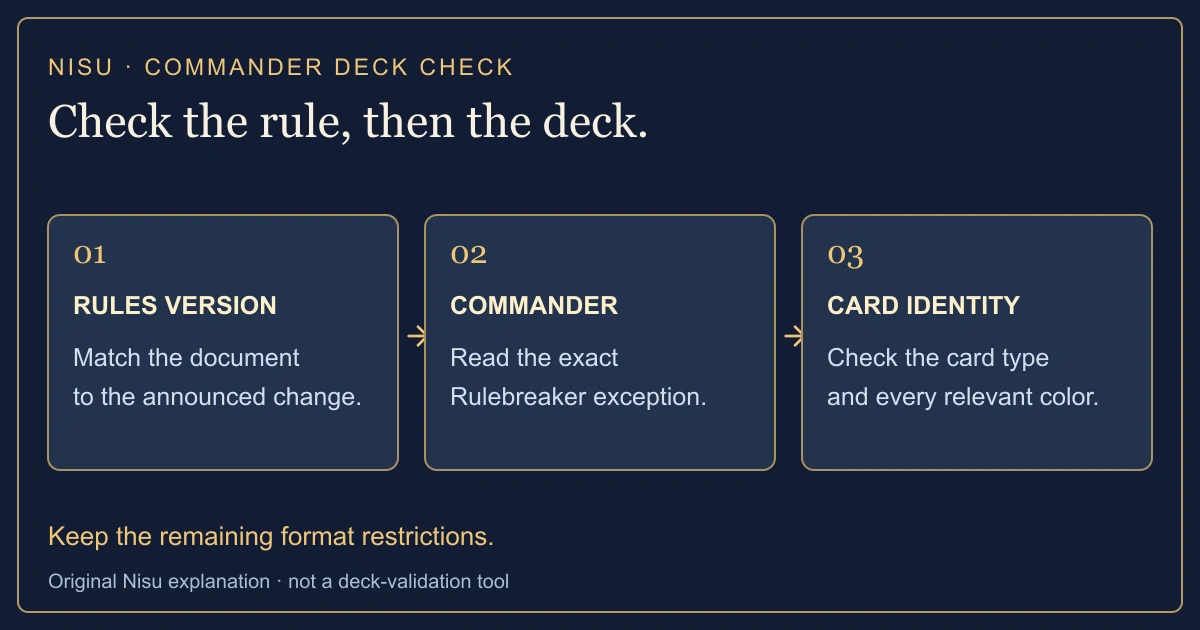
For a deck check, identify the normal restriction first, then write down exactly which part the commander changes. Keep the remaining restrictions. This avoids treating the word Rulebreaker as a general pass for extra colors, duplicates or extra commanders.
Meld classification changes specific interactions
Under the announced update, meld cards move out of the double-faced-card category. That matters when another card specifically checks for a double-faced card. The bulletin names Overgrown Pest as an example of an effect whose interaction with meld cards changes. It does not announce a general change to every card with two printed sides.
In the update discussion, GrizzlyBearSmackdown asks about a Tetzin, Gnome Champion deck. Gatherer’s current card page checks for another double-faced artifact entering under your control. Under the announced classification, a meld card does not satisfy that double-faced condition. That identifies the affected interaction; it does not by itself ban a card or settle which dated rules your event applies.
Classifying a card and performing a game action are separate questions. The announcement says there are no other functional changes to meld. A pair still needs its actual meld instruction; the announcement does not create a new way to transform or convert a meld card.
Keep the published-version distinction in view. The September 25 rules download still lists three kinds of double-faced cards, including meld cards, in section 712. Its section 713 is Substitute Cards. The bulletin’s proposed section 713 is Meld Cards. For an interaction today, use the version applicable to the game rather than combining one document’s heading with another document’s rule.
Tolabow checks color identity, not only the card’s color
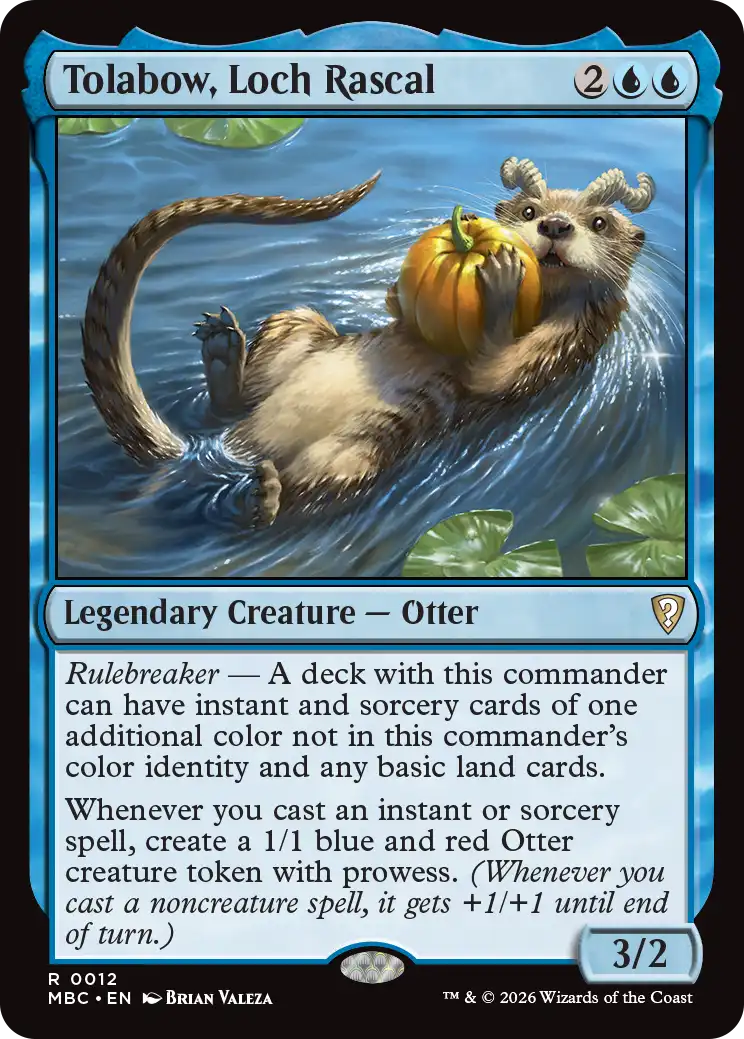
Wizards’ corrected Tolabow text lets you choose one additional color beyond the commander’s color identity for instant and sorcery cards. For Tolabow alone, the August explanation tells you to choose a color other than blue. Those spells can have blue, the chosen color, both, or no color in their identity. A third color falls outside that allowance.
Use the entire color identity, including relevant mana symbols in rules text. Wizards’ red-choice example permits Mystic Retrieval, whose blue spell has a red flashback cost, but excludes Ancient Grudge because its identity also contains green. Looking only at the mana cost or the card frame misses that distinction.
The exception is for instants and sorceries, with a separate allowance for basic land cards. It does not give every creature, enchantment or nonbasic land an extra color. A nonbasic land also does not become a basic land because it has a basic land type.
Before adding a card, check its current Oracle text, type and complete color identity. The official image is provided for identification; Wizards’ August correction and current Oracle text control the wording. Your chosen extra color is a deckbuilding choice, not something to switch whenever you cast a different spell.
| Tolabow alone; choose red | Result under Wizards’ corrected text |
|---|---|
| Blue and/or red instant or sorcery | Fits the added-color allowance, subject to other format restrictions. |
| Instant with red and green in its color identity | Does not fit; green is a third color. |
| Red creature without another applicable exception | The instant/sorcery allowance does not admit it. |
| Basic land card | Covered by Tolabow’s separate basic-land permission. |
| Nonbasic land | Check normal restrictions; the basic-land permission does not apply. |
Separate housekeeping from changes to how you play
The bulletin’s smaller entries do not all introduce a new game action. The counter rule 122.1g is brought into line with the existing state-based action for a non-Siege battle at zero defense. That is not a reveal of a new battle card or a promise about a future set.
The card-name rule clarifies that an Adventure’s spell name can be chosen. The resolving-spells rule clarifies your choice of order when an effect lets you cast more than one spell during resolution. Neither sentence means you can ignore an effect’s other restrictions or take an unrelated action during resolution.
The bulletin also adds seven planeswalker subtypes, includes Rulebreaker among ability words and consolidates rules for objects changing zones. Those entries help you find the relevant instruction. They do not establish a universal creature-type erratum or new Commander ban list.
Commander Draft permissions stay in Commander Draft
Mystery Booster Commander Edition’s draft rules are a separate part of the release notes. Players draft two cards per pick from three boosters, then build a deck of at least sixty cards including the commander. Duplicates from the drafted pool are permitted. Ordinary Constructed Commander instead uses exactly one hundred cards including the commander and its usual singleton restriction, unless a specific legal card changes it.
The set’s draft variant also grants a partner option to eligible commanders with one or fewer colors that do not already have partner. It has fallback color choices for difficult draft pools. These provisions solve a Limited deckbuilding problem; they are not a blanket upgrade to your Constructed Commander cards.
Card legality is another check. A reprint does not gain new format legality merely by appearing in this product. Wizards lists the new non-acorn MBC cards 1–60 for Commander, Legacy and Vintage, rather than Standard, Pioneer or Modern. Playtest cards and acorn cards have their own Limited-only boundaries. Check the actual card and your event’s format before bringing a drafted card into a constructed deck.
| Before you build | This set’s Commander Draft | Ordinary Constructed Commander |
|---|---|---|
| Deck size | At least60, including the commander | Exactly 100, including the commander, subject to a specific exception |
| Duplicate cards | Permitted from the drafted pool | Singleton apart from basic lands and specific exceptions |
| Partner and fallback colors | Use the set’s stated draft provisions | Do not import the draft-only allowances |
| Legality | Use the event’s Limited rules | Check the card’s format legality and current ban list |
Check the cards that actually depend on the update
Start with a narrow list: your commander, any meld cards you use, and effects that explicitly mention double-faced cards. Write the exact interaction you expect. A claim that a card is generally “nerfed” is harder to check than a question about whether it satisfies one named condition.
Next, record your format and the applicable rules version. Read the current Oracle text for both cards together. For a Rulebreaker deck, note the chosen extra color or other exception before checking the rest of the list. For a meld interaction, distinguish the published September classification from the October announcement.
Change only what the verified interaction requires. A classification change does not by itself change a card’s color identity, replace the ban list or require rebuilding every Commander deck. If a tournament decision remains disputed, show the judge the dated rule and both cards’ current text instead of relying on a cropped social post.
Watch a dated review of the new commanders
The Command Zone’s August 25 review discusses the new legends and includes Whtz, the Bibliophile, whose deck-size exception is a useful contrast with Tolabow’s extra-color permission. The creators’ rankings are their opinions. Use the episode to see the cards and their deckbuilding ideas, then return to Wizards’ text for a ruling.
This recording predates the October 19 bulletin. It does not verify the announced meld recategorization or settle which Comprehensive Rules version your event uses. Nisu has not played these decks or tested a matchup from the episode.
August 25, 2026 card review, including Whtz. Creator opinions and deck ideas; recorded before the October 19 update bulletin, not an authority for its current rules status.
Quick help
Has the downloadable Comprehensive Rules document caught up with the bulletin?
The official download checked on October 21 was still effective September 25, 2026. It retains the earlier meld classification and uses 903.5e for sideboards. The October 19 bulletin describes planned changes; use the current official document and the version applicable to your event.
Does the announced meld change affect Tetzin’s double-faced-artifact trigger?
Under the announced classification, a meld card does not meet that double-faced condition. Tetzin’s current Gatherer text supplies the condition; the September 25 rules download still has the earlier meld classification. Confirm the applicable rules version before changing the interaction.
Does the non-Siege battle correction confirm new battle cards?
No. The bulletin aligns the counter rule with an existing state-based action. It does not identify a future battle card or establish the community’s predictions about later sets.
Does Rulebreaker work if the card is in the 99?
No. Wizards’ release notes require it to be your designated commander and place its effect before the game. The card’s exact exception still determines which deckbuilding restriction changes.
Does choosing red with Tolabow allow every red card?
No. The added-color permission concerns instant and sorcery cards, plus a separate permission for basic lands. Check complete color identity, including relevant mana symbols in rules text; the exception does not generally admit red permanents.
Can I use the draft partner and extra-color options in a normal Commander deck?
No. Those are provisions for this product’s Commander Draft. An ordinary Constructed Commander deck follows its own deck size, singleton, legality and commander rules unless a specific applicable card creates an exception.
Source and scope
Independent guide checked October 21, 2026. The official download linked on that date is effective September 25; October 19 bulletin changes are labelled as announced, not silently substituted into that document. Answers use Wizards’ bulletin, release notes and Tolabow correction; community questions identify player concerns, not rules authority. This Nisu guide is unofficial Fan Content under Wizards’ Fan Content Policy. Wizards has not endorsed it. Card artwork and text belong to Wizards of the Coast LLC.
- October 19, 2026 update bulletin: announced changes
- Official rules landing page: current downloads
- Comprehensive Rules download checked October 21; effective September 25, 2026
- August 3 Tolabow Oracle correction and color-identity examples
- Release notes: Rulebreaker, Commander Draft and card legality
- Tetzin, Gnome Champion: current official card text and rulings
- Player discussion: meld-dependent decks, document timing and battle clarification
- Wizards’ Fan Content Policy and attribution conditions