

Practice the one-position rule first
For the fixed-length ladders on this page, replace exactly one letter in its existing position at each step. Every intermediate entry must be a word. Do not insert, remove or rearrange letters.
Choose your dictionary convention before comparing scores: four-letter words, accepted regional spellings, plurals and any excluded names or abbreviations. A word can be ordinary English and still be absent from one game’s chosen list.
The two exercises below use common four-letter words. Try them before opening the worked answers in the questions at the end. They are a reusable worksheet, not a claim to publish a different official puzzle every day.
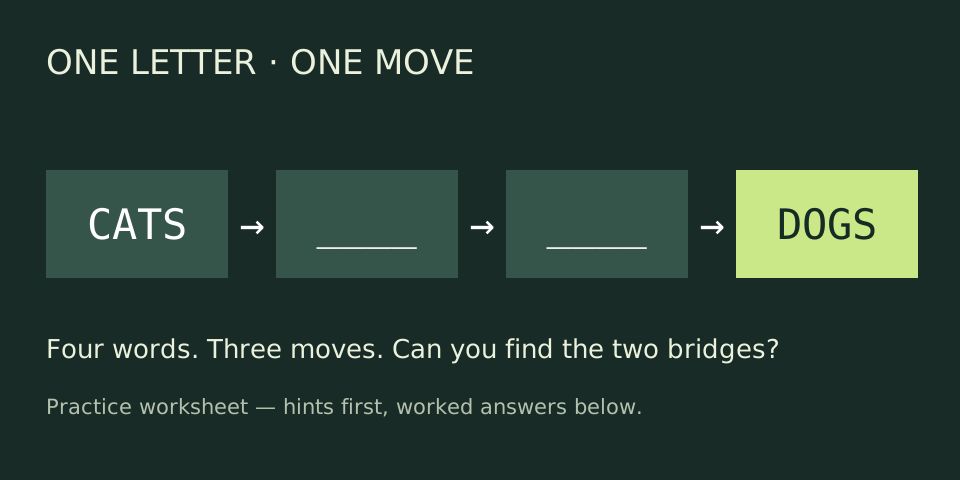
Exercise 1: turn CATS into DOGS
Start: CATS. Goal: DOGS. Try to connect them in three moves. There are two intermediate words to find, making four words in the completed chain.
First hint: the final S already matches. Compare the other positions separately instead of treating the letters as an anagram. Second hint: one useful intermediate word means small beds; another means small round marks.
After finding a route, check each transition by writing the changed position beside it. A convincing-looking chain is not enough if even one arrow changes two letters.
| Position | Start | Goal | Needs changing? |
|---|---|---|---|
| 1 | C | D | Yes |
| 2 | A | O | Yes |
| 3 | T | G | Yes |
| 4 | S | S | No |
Exercise 2: turn BOOK into FOOD
Start: BOOK. Goal: FOOD. Find a route using real words and one changed position per move. This exercise is about finding a connection, so no shortest-path target is promised.
First hint: the two middle O letters already match, but that does not make a two-move route automatic. You still need valid words between the endpoints. Second hint: possible bridge meanings include a benefit, the object orbiting Earth and an emotional state.
When you reach the goal, ask which steps changed a letter without immediately reducing the number of mismatches. Useful progress can involve a bridge word, rather than making the spelling look closer at every single turn.
A ten-minute routine you can repeat
Minutes 0–2: choose your rules and solve a short warm-up. Say which position changes at each step. Focus on legal transitions before speed.
Minutes 2–6: attempt one harder pair or the current daily puzzle in a game you already use. Keep a few candidate bridge words on paper. If you get stuck, look backwards from the destination and try to connect the two sides.
Minutes 6–8: check a hint or compare a completed route. Identify one rejected word, repeated loop or missed connection. Record the reason, not just the final score.
Minutes 8–10: replay the route from memory, then choose a small goal for the next session: clearer position checks, fewer repeated words or learning two useful bridge words. The time split is a suggested practice routine, not a tested learning-rate claim.
Count moves and understand a shortest-path claim
Moves are transitions: a five-word chain contains four moves. Count the arrows rather than including the starting word as a move.
The number of positions that differ between the endpoints is a lower bound. Each mismatch must be changed at least once, but accepted intermediate words can require more steps. That lower bound alone does not prove a route exists.
CATS and DOGS differ in three positions. The worked answer uses three legal changes, so it meets that lower bound when its intermediate words are accepted. The BOOK example provides a valid route, but this page does not claim it is the shortest under every dictionary.
To prove a shortest route in a particular game, its actual accepted word list matters. A general dictionary solution should not be labeled an official game answer without that check.
Move from paper practice to a daily game
The original Feetle game gives a new starting word each day and a fixed destination of FEET. Its official rules use the same one-letter substitution idea. Nisu’s related Feetle guide explains that game, while the Poople guide covers its different destination and accepted-list constraints.
Keep your worksheet, a practice mode and a shared daily result separate. Before comparing with a friend, match the game, puzzle identifier, starting word and word-list rules. A shorter route on an independently operated version may answer a different puzzle.
These exercises do not require an account, a downloaded game or a new solver. You can work them on paper, then use an existing game for its own current challenge.
Quick help
Show the worked answer: CATS to DOGS
CATS → COTS → DOTS → DOGS. Change position 2 (A to O), then position 1 (C to D), then position 3 (T to G). Four words, three moves. This meets the three-position lower bound if COTS and DOTS are accepted.
Show one worked answer: BOOK to FOOD
BOOK → BOON → MOON → MOOD → FOOD. Change position 4, then 1, then 4, then 1. Five words, four moves. This is a valid English-word example, not a universal shortest-path claim.
Why did a real English word get rejected?
A game uses its own accepted list and rules. Check its word length, spelling policy, exclusions and the number of changed positions before treating rejection as an error.
Source and scope
The one-position substitution rule was checked against Carroll’s published Doublets rules, and the official Feetle instructions were checked October 23, 2026. Both practice routes below were independently checked for word length and every adjacent letter change. They are English-language exercises, not guarantees about a specific game’s accepted word list or daily puzzle.