
Find the right RoFront experience
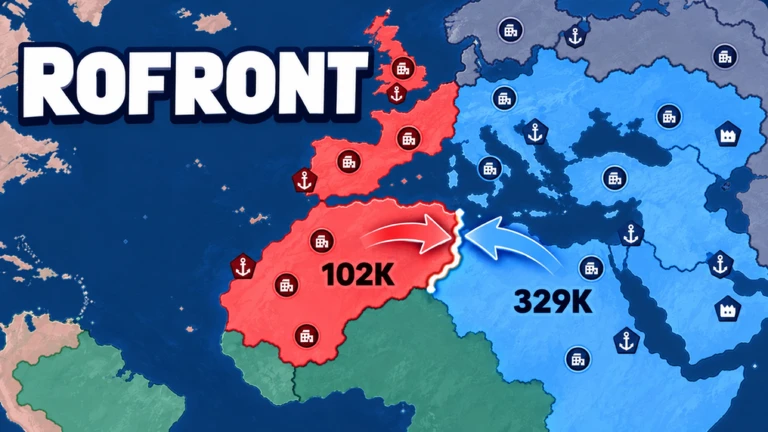
RoFront [World PvP] is a Roblox strategy experience by Torrey Pines. The official description calls it real-time territory conquest based on Open Front and credits Open Front for the map. You begin with a single nation, expand, attack neighbors and compete for control of the world.
Use the official Roblox link above and check the creator name. Searches for similar names can lead to unrelated games or videos. RoFront is a map-based strategy game; a tutorial for the Roblox shooter Frontlines will not explain this experience.
The published victory condition is to conquer 80% of the world. Keep that goal in view while learning the other systems. A successful local attack can improve your position, but it does not by itself complete the match. Nisu’s guide provides a starting plan and a player-video reference; we have not played a live RoFront match ourselves.
Read your position before expanding
For a first match, take a moment to locate your territory, its borders and the neighboring nations. The official loop includes attacking neighbors, so knowing who shares your boundary is a useful starting point. Look for the world-control display as well, rather than judging progress only by how large your colored area appears at the current zoom.
Our suggested learning routine is to make one deliberate move and watch what changes before repeating it. Notice the territory gained, the information shown for your nation and any change along another border. This gives you a reference for the next decision without requiring an unverified opening build order.
If a push goes poorly, identify the decision you want to change next time. Was the target poorly chosen, did you overlook a neighboring threat, or did you commit without understanding the current controls? Those are questions to investigate in your match, not claims that a particular attack percentage always wins.
Use gameplay footage to learn the interface
APEX ROBLOX’s October 10 video follows a RoFront match from a small territory into a larger position. Around the sampled four-minute point, the screen shows the world-control goal at the top, colored borders across the map and the player’s troop, gold and attack controls below. Watch where the player looks before each action.
Pause on the interface and match one visible control to the action that follows. Then resume long enough to see the result. This is more useful for a beginner than copying a number from a single frame: the player’s resources, neighbors and territory change throughout the match.
The recording includes a visible 2× speed marker in the sampled segment. Do not use its playback timing as a real-time income or attack-speed measurement. It is a player demonstration of this particular match, not proof of an optimal strategy or the outcome you will get.
Player match footage. Watch the world-control meter and the map before each move; the sampled segment is shown at 2× speed.
Give buildings and alliances a purpose
The official description names cities, ports and factories as things you can build. Inspect the current options and their displayed costs before deciding what comes next. The listing does not provide a complete economy table, so it cannot establish a universal cheapest route to victory.
A useful first-session question is: what am I trying to improve with this choice? Read the information shown for the building, compare it with your present situation, then watch the result. Treat cities, ports and factories as separate options to learn, rather than buying whichever icon a video happens to show first.
Alliances and nuclear attacks are also part of the published feature set. Read the relevant in-game controls before acting, especially when an action can change relationships with other nations. A dramatic nuclear strike in a video does not establish that rushing toward it is the best opening for every position.
| Published feature | What to check in your match |
|---|---|
| Territory expansion | Your borders, target and world-control progress |
| Cities, ports and factories | Current description, cost and intended benefit |
| Alliances | Who is involved and what the current controls offer |
| Nuclear attacks | Requirements and the consequences of the selected action |
Keep the 88-nation claim separate from server size
The description refers to 88 player nations and hundreds of tribes. On the same official Roblox page, the separate Server Size field showed 30 when checked on October 11. These are different fields, and the listing alone does not explain how the two counts relate.
This guide therefore does not promise an 88-player server or treat 88 as a tested simultaneous-player capacity. Use the current Roblox server information when choosing where to join. Neither the map description nor the size of a crowd in a recording establishes device compatibility or performance for your setup.
For your first session, focus on understanding a few decisions: recognize your position, make a measured expansion, inspect a building and follow the control meter toward the stated 80% goal. Afterward, review the move that changed your position most. The related Nisu games below offer separate base-building or rule-learning activities; they are not RoFront and do not share its progress.
Quick help
How do you win RoFront?
The official Torrey Pines description says to conquer 80% of the world. Follow the world-control display in the match rather than assuming one large territory or attack has won the game.
Does RoFront support 88 players in one server?
The description mentions 88 player nations, but Roblox’s separate Server Size field showed 30 when checked. We have not tested live capacity and do not equate the two figures.
What should I build first?
Inspect the current city, port and factory options and choose according to your position and their displayed requirements. The official listing does not establish a universal optimal buying order.
Source and scope
This independent guide draws on Open RoFront on Roblox, checked on Oct 11, 2026. Published requirements and rules come from the linked sources; practice routines and examples are Nisu editorial suggestions.
 Play now